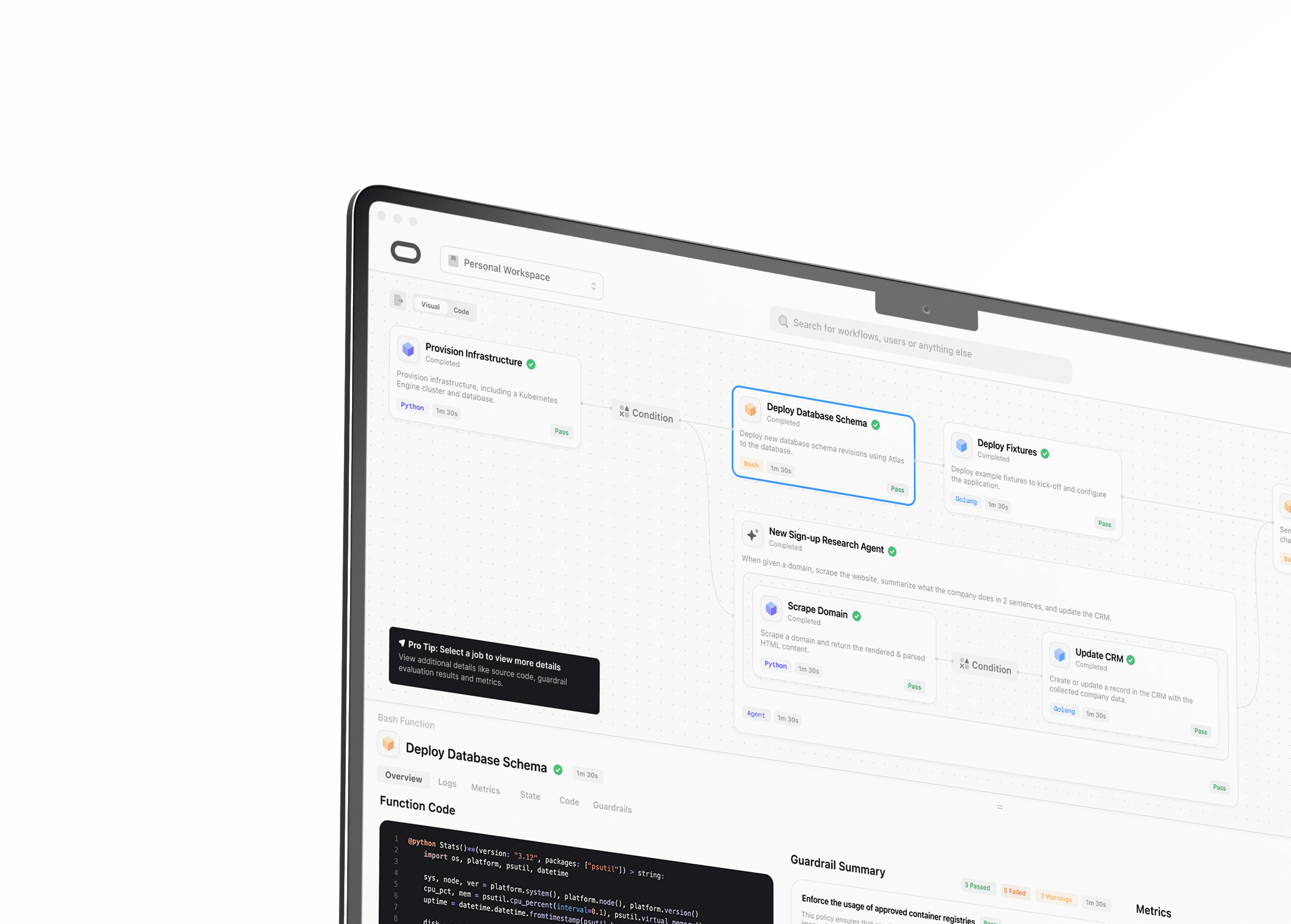
Run anything.

Anywhere.

All at once.

Run anything.

Anywhere.

All at once.

Get in

The Platform

Limitless power. Zero friction.

Orchestrate every component of your architecture through a perfectly unified experience.

One language. Every discipline.

Unite every engineering team on a single orchestration surface. Build CI/CD pipelines and machine learning jobs without switching contexts.

Intelligence, delegated.

Hand your functions over to an AI agent and let it dynamically chart the execution path.

Every runtime, united.

Treat Python, Rust, Java, Bash, and Go as first-class citizens. Pass state across distinct environments without writing any glue code.

Every runtime, united.

Treat Python, Rust, Java, Bash, and Go as first-class citizens. Pass state across distinct environments without writing any glue code.

Fail-safe by design.

Protect workflows with a unified type system that enforces strict return contracts. Safely catch distributed execution failures before they crash your application.

Boundless execution.

Transparently dispatch runtime invocations to machines across the globe. Scale infinitely without changing the shape of your core program.

Instant scale. Zero wait.

Launch functions in milliseconds using a warm pool of standby executor pods. Eradicate cold-start latency so your logic executes the moment it is invoked.

Native Runtime Support

Theory say goodbye to version chaos and embrace a smoother workflow designed to help your team achieve more, together.

Proactive Guardrails

Theory say goodbye to version chaos and embrace a smoother workflow designed to help your team achieve more, together.

Fail-safe by design.

Protect workflows with a unified type system that enforces strict return contracts. Safely catch distributed execution failures before they crash your application.

Boundless execution.

Transparently dispatch runtime invocations to machines across the globe. Scale infinitely without changing the shape of your core program.

Instant scale. Zero wait.

Launch functions in milliseconds using a warm pool of standby executor pods. Eradicate cold-start latency so your logic executes the moment it is invoked.

The Pillars

For every team, everywhere.

Empower every discipline to execute everything from CI/CD pipelines to machine learning training jobs seamlessly across the globe.

One platform. Every workflow.

Unify any workflow on a single, elegantly simple platform.

Chat your workflows into existence.

Harness the power of native AI to instantly design, iterate, and deploy workflows using natural language.

Harness the power of native AI to instantly design workflows.

Scroll to view chat

The world is your runtime.

Map every step to the perfect machine. Run it on any continent. Effortlessly.

Build together. In perfect sync.

Empower cross-functional teams to collaborate in a shared workspace.

The Disciplines

All your workflows. One language.

Orchestrate machine learning, data pipelines, and infrastructure & application deployments using a single unified surface.


01
Machine Learning
Theory transforms machine learning by natively embedding Python models directly into your architecture, eliminating siloed platforms like Kubeflow or MLflow. Data scientists can write standard Python and import PyPI packages like PyTorch and TensorFlow right into the core workflow. The orchestration engine automatically dispatches compute-heavy workloads to specialized worker nodes that match hardware constraints, like GPU availability, using simple runner annotations. Data preparation, training, and inference seamlessly scale alongside the rest of your engineering logic.
02
Continuous Integration & Deployment
03
Data Processing

The Language

Code without boundaries.

Master your distributed, polyglot reality using one elegant, universally declarative language.

@workflow RobustWorkflow():

batches = FetchBatches()


# Iterate over the list returned by the Python runtime

for batch in batches:

try:

# Attempt to process the batch in the isolated container

score = ProcessBatch(batch)


# Branching logic based on the returned integer

if score >= 90:

Alert("INFO", "Batch {batch} passed with high quality: {score}")

else if score >= 50:

Alert("WARN", "Batch {batch} passed with acceptable quality: {score}")

else:

Alert("ERROR", "Batch {batch} failed quality checks.")


catch err:

# Catch the execution failure safely without crashing the loop

Alert("FATAL", "Execution failed for {batch}. Reason: {err}")


print("All batches evaluated.")


@python FetchBatches() > list:

# Returns a list of strings to iterate over

return ["batch_01", "batch_02", "corrupt_batch", "batch_03"]


@container ProcessBatch(string batchId)**(

image: "ubuntu:22.04"

) > int:

# Simulate a failure for the corrupt batch

if [ "$batchId" = "corrupt_batch" ]; then

echo "Fatal error reading batch data" >&2

exit 1

fi


# Return a simulated quality score (int) via $__THEORY

echo "95" > $__THEORY


@bash Alert(string level, string message) > int:

# Standard logging. Omitting '> type' implicitly returns 'none'.

echo "[$level] $message"


@workflow RobustWorkflow():

batches = FetchBatches()


# Iterate over the list returned by the Python runtime

for batch in batches:

try:

# Attempt to process the batch in the isolated container

score = ProcessBatch(batch)


# Branching logic based on the returned integer

if score >= 90:

Alert("INFO", "Batch {batch} passed with high quality: {score}")

else if score >= 50:

Alert("WARN", "Batch {batch} passed with acceptable quality: {score}")

else:

Alert("ERROR", "Batch {batch} failed quality checks.")


catch err:

# Catch the execution failure safely without crashing the loop

Alert("FATAL", "Execution failed for {batch}. Reason: {err}")


print("All batches evaluated.")


@python FetchBatches() > list:

# Returns a list of strings to iterate over

return ["batch_01", "batch_02", "corrupt_batch", "batch_03"]


@container ProcessBatch(string batchId)**(

image: "ubuntu:22.04"

) > int:

# Simulate a failure for the corrupt batch

if [ "$batchId" = "corrupt_batch" ]; then

echo "Fatal error reading batch data" >&2

exit 1

fi


# Return a simulated quality score (int) via $__THEORY

echo "95" > $__THEORY


@bash Alert(string level, string message) > int:

# Standard logging. Omitting '> type' implicitly returns 'none'.

echo "[$level] $message"

@workflow Workflow():

# Call any runtime like magic.

ids = GetIDs()

# Use operators you know.

for id in ids:

try:

res = Run(id)


if res >= 90:

Log("{id}: OK ({res})")

else:

Log("{id}: LOW ({res})")

catch e:

Log("{id}: FAIL. {e}")

print("Done.")


@python GetIDs() > list:

return ["id1", "err", "id2"]


@container Run(string id)**(

image: "ubuntu:22.04"

) > int:

if [ "$id" = "err" ]; then

exit 1

fi

echo "95" > $__THEORY


@bash Log(string msg) > none:

echo "-> $msg"

The Theory

Our Manifesto

The modern engineering landscape is fractured by a fragmentation tax that forces developers to bridge the gap between machine learning models, infrastructure code, and disparate runtimes using fragile, trigger-based tools like GitHub Actions and Airflow. This technical debt creates invisible walls where state cannot flow easily between disciplines, and the cognitive load of switching between execution models stifles innovation. Theory is born from the necessity to bring these engineering disciplines back together under a single, declarative surface. By providing a unified orchestration language that treats every runtime—from Python and Rust to Bash and Containers—as a first-class citizen, Theory dissolves the boundaries between infrastructure, model training, and data processing.


Theory replaces the rigid, fragmented orchestrators of the past with a distributed execution operating system designed for the polyglot reality. We are not replacing specialized, industry-standard tools like TensorFlow or Terraform; instead, we are providing the professional-grade nervous system they run on. In a standard stack, moving data from a data pipeline to a CI/CD pipeline requires custom APIs or manual serialization. Theory eliminates this overhead with a universal type system that allows a result from a Python-based TensorFlow job to be passed directly into a Go or Bash-based Terraform script without manual, error-prone JSON parsing.


The platform functions as a stateful central brain that manages variable scope and execution logic across a global fleet. Every transition within a workflow is fully persistent, ensuring that the system maintains a perfect record of the program’s state at all times. This ensures total durability; if an underlying system failure occurs, the platform can resume a workflow exactly where it left off, ensuring no lost state and no silent failures. This reliability allows engineers to focus on the logic of their work rather than the stability of the underlying infrastructure.


The execution model is designed to be distributed by default, managing the lifecycle of work across diverse compute environments. The platform intelligently routes tasks to the most appropriate resources, whether that requires high-performance hardware for heavy computation or lightweight environments for administrative tasks. To ensure high performance, the system maintains ready-to-use environments that eliminate the latency typically associated with starting new tasks. This allows a single Theory workflow to orchestrate a complex sequence of events, from training an AI model to deploying the cloud resources it requires, all within a unified execution window.


By replacing the fragmented overhead of legacy CI/CD and workflow tools, Theory returns engineering hours to what actually matters: building products. We are moving beyond the era of specialized silos into an age of universal orchestration where asynchrony and distribution are baked into the syntax rather than bolted on as an afterthought. Theory provides the grounded, supportive, and scalable foundation for any engineering discipline to execute any workflow on the same platform. It is the fundamental layer that allows diverse tools to speak the same language, ensuring that the only limit to an engineering pipeline is the logic of the theory itself.

Tom Gouder

Founder

THEORY BETA ACCESS

Sign-up for Early Access